Carl Zeiss "Dosenfernrohr kleines Modell"
|
Carl Zeiss "Small Revolver Telescope"
|


nr15.jpg)
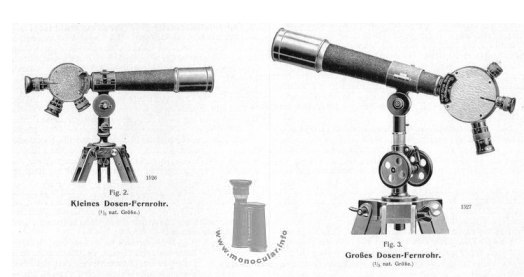
| Das kleine Dosenfernrohr ist 37cm lang. Die Okulardose ist 85mm im Durchmesser und 33mm dick, die seitlichen Kanten sind abgerundet. Auf dem letzten Foto sieht man die Einrastfeder für die Okularstellungen an der Dose. Die drei Okulare haben folgende Länge und Augenmuscheldurchmesser: 12x - 30mm lang, 33mm Durchmesser; 18x - 40mm lang, 35mm Durchmesser; 24x - 47mm lang, 38mm Durchmesser. Die Augenmuscheln sind komplett aus bräunlichem Bakelit (3/3 Typ) und haben eine Teilskalierung von Null bis +20. Der mit einer Gabelhalterung an der Okulardose befestigte konische Objektivtubus verbreitert sich von 30mm auf 45mm im Durchmesser; die Objektivlinse ist 44mm, die gerade Fassung 50mm. Die Okulardose und der Aluminiumtubus sind aus blankem Aluminium, am konischen Tubus gab es eine Umwicklung mit dunklem Leder oder Hanf ("Türkische Bund"), dessen Rest am Ansatz noch vorhanden sind. | The small Revovler Telescope is 37cm long. The prism box is 85mm in diameter and 33mm thick with rounded edges. The last photo shows the catch spring on the can that fixes the oculars' position. The three eyepieces have the following length and diameter: 12x - 30mm long, 33mm diameter; 18x - 40mm long, 35mm diameter; 24x - 47mm long, 38mm diameter. The eyecups are completely made of brownish hard rubber (3/3 type) and have a halfway round dioptre lines marked from zero to plus twenty. The conical objective tube is attached with a fork mount to the prism housing. The tube increases from 30mm to 45mm in diameter and ends with a straight 50mm objective frame, holding the 44mm objective lens. The tin can and the tube are made of aluminium without lacquering, and the conical tube shows remains of a taping with dark leather or hemp ((Turk's head knot). |


| Ein weiteres kleines Dosenfernrohr mit Nr. 95 aus Privatbesitz ist als solche beschriftet und mit einer Klemmschelle auf dem originalen Stativzapfen ausgestattet. Die 2/3-Augenmuscheln sind mit 12x, 18x und 24x sowie einer umlaufenden Dioptrienskala von + bis - 5 gekennzeichnet. Eine ausziehbare Sonnenblende sowie die Abdeckkappe sind vorhanden. Die Schutzkappe hat eine Art Bajonettschlitz, mit dem sie an einer Schraube am Objektivrand eingehakt wird. Die vorliegenden Modelle Nr. 89 und 100 weisen die gleichen Baumerkmale auf, Nr. 89 hat aber keinen Einhahakknopf an der Sonnenblende für die Objektivkappe. | Another small "Dosenfernrohr" with number 95 from a private owner is already marked as such and has a clamp holder for the tripod. The 2/3 eyecups are marked 12x, 18x and 24x, and have full dioptre scales ranging from + to - 5. There is a intact ray-shade and a lens cap, too. This protection cap has a sort of bayonet slit which hooks into a tiny screw on the objective frame's rim. The known models No. 89 and 100 come with the same design features. No. 89 has no screw on the ray-shade tube to hook in the lens cap. |
closed.jpg)
ext.jpg)
lab.jpg)
rev.jpg)


| Für das kleine Dosenfernrohr gab es ein Holzstativ - am Anfang (Kaztalog 1899) auch ein Aluminiumstativ und eine Baumschraube - und eine Ledertragetasche. Das Dosenfernohr war das erste in Serien produzierte Handteleskop mit geradsichtigem Prisma und wechselbarer Vergrößerung. Dafür wurde ein geradsichtiges Abbe-Amici-Prisma in das runde Prismengehäuse eingebaut (s. letzten beiden Fotos). Die Montageschrauben der Stütz- bzw. Befestigungsstege für das Prisma waren beim ersten "Handfernrohr" außen auf dem Gehäusedeckel noch sichtbar (s. Foto 5). |
A wooden tripod and a leather carrying case were available for the small model - at the beginning (catalogue 1899) an aluminium tripod and a tree-screw were also offered. The Revovler Telescope was the first straight-sighted prism handheld telescope with changeable power that was produced in series. A straight-sighted Abbe-Amici prism was fixed in the round prism box (see last two pics). The small fixing screws for the mounting racks of the prism were still visible on the surface of the prism box of the first "Handfernrohr" (see photo 5). |


 .
.
| Das kleine Modell des Dosenfernrohrs wird ab 1899 bis zum Katalog 1905 angeboten. Im Katalog der "Stand- und Aussichtsfernrohr" von 1907/09 (?) wird nur noch das große Modell aufgeführt. | The small Dosenfernohr model was offered since 1899 in the catalogues until 1905. In the 1907/09 (?) catalogue for "Stand- and Observation Telescopes" only the large model was listed. |
Fotos: Zeun; 3 Louwman Historical Collection of Telescopes; 9-12 S. Tomlinson