Carl Zeiss Jena 4x20 (M.Blink 16 /M.Sig 16)
| Ein Monokular von Carl Zeiss Jena von ca. 1917/1918/19 (datiert nach Seriennummern). Es hat eine 4fache Vergrößerung, einen Objektivdurchmesser von 20mm, ein Gewicht von 119g und ist 70-75mm lang mit einem Gehäuse von 38x38 mm oben bzw. 40x40mm unten am Gehäuse. Die Deckel haben keine Verschraubungen. | A monocular by Carl Zeiss Jena from anout 1918/19 (acc. to serial number). It has a 4x magnification, objective lens diameter of 20mm, weighs 119g, and is 70 to 75mm long with a body of 38x38mm at the top and 40x40mm at the bottom of its housing. |
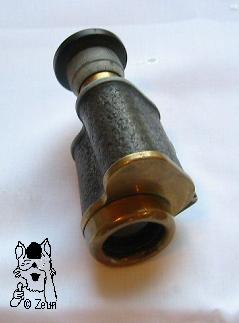
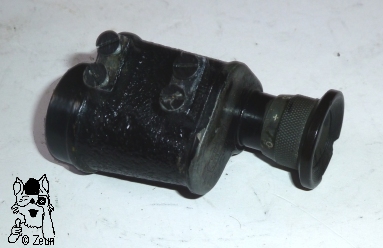
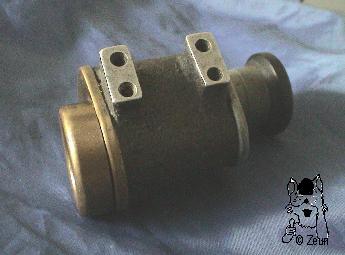
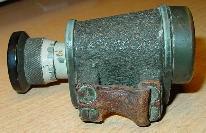
| Das Monokular hat einen Dioptrienausgleich von + - 5. Das Gehäuse ist in der Regel anthrazit oder grau lackiert, nur manchmal lederummantelt (evtl. nach dem Kriegseinsatz). Die Objektivseite eines der hier abgebildeten 4x20 ist mit einer Messingplatte abgedeckt und einer messingen Linsenhalterung ausgestattet. Andere Modelle haben Zink/Aludeckel. |
The monocular has a dioptre range of +/- 5. The body is usually covered with a anthracite or greyish paint, only sometimes covered with leather (probably after the use during war). The objective side of one of the 4x20s shown here is covered with a brass plate and a brass lens frame. Other models come with zinc/aluminium cover plates. |
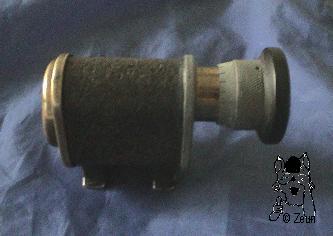
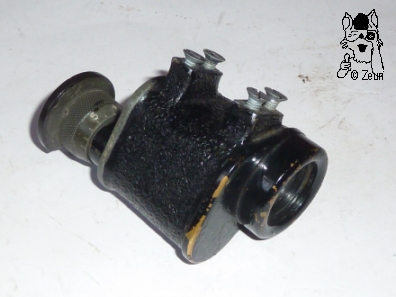
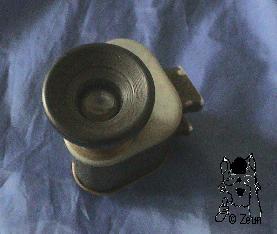
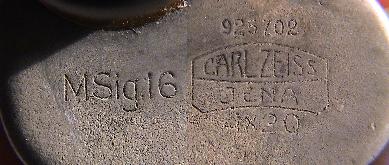
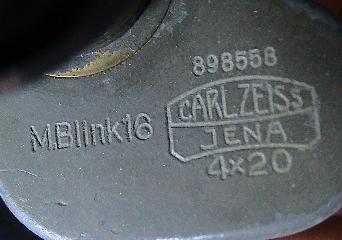
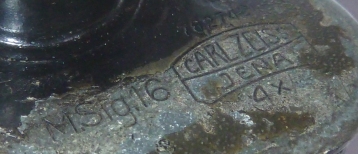
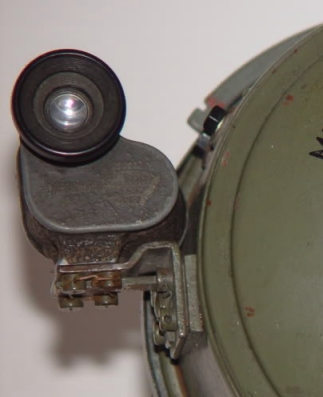
Am Okular befindet sich eine Bakelit-Augenmuschel. Diese Seite hat eine grausilberne (Aluminium) Prismenabdeckplatte mit der Beschriftung "Carl Zeiss Jena" im Linsenlogo sowie "4x20" und die Daten "M.Sig 16", Seriennr. "932702". Ein weiteres Exemplar hat die Beschriftung "M.Blink 16", Ser.Nr. "898558" (s. Detailfoto). Das fühere Exemplar (s. Foto 2) von 1917 hat die Seriennummer 762742 und ist außer mit "M.Sig 16" lediglich mit "4x" gekennzeichnet, hat aber auch eine am unteren Deckelrand eingeschlagene Militärnummer. Letztere ist kaum zu erkennen - evtl. lautet sie '090014'. |
There is a Bakelite eye cup. This side has a grey (aluminium) prism cover plate with the markings "Carl Zeiss Jena" inside the lens logo, "4x20" and "M.Sig 16" as well as the serial number "932702". Another specimen is stamped "M.Blink 16", ser.no. "898558" (s. detail photo). The earlier model (see photo 2) from 1917 has the serial number 762742, and is marked only with "4x" apart from "M.Sig 16". But it has a military number stamped into the lower cover palte's rim - hard to decipher, but probably '090014'. |
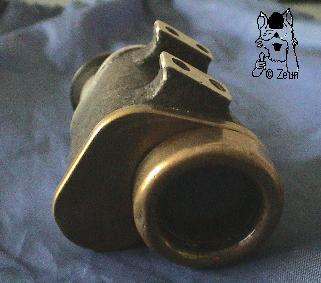
Diese Monokulare wurden im 1. Weltkrieg an sogenannten Signal- und Blinkgeräten montiert, die zur Nachrichtenübetragung im Feld dienten. Da die Lichtsignale schwach gehalten wurden, damit sie nicht vom Feind mit bloßen Auge sichtbar waren, brauchte man Ferngläser, um das Blinken anzuvieseiren und besser zu sehen. Das "M" steht für "mittleres". Zur Montage an den Blinkgeräten hat das Gehäuse zwei Füßchen, die jeweils zwei Schraub-/Gewindelöcher haben. Aus einem andern Ebay-Verkauf lässt sich ersehen, dass dort z.B. ein kleiner Lederriemen angebracht war. Beim frühen Modell sind die Befestigungsschrauben noch vorhanden. |
Durinmg WWI these monoculars were used at socalled signal- and blink-devices, which functioned as mesaging systems. As the signalling lights were quite weak, so they could not be seen with bare eyes by the enemy, binoculars or monoculars were needed to locate and watch the blinking signals. The mono has two feet with threads to fix it to the blink device. Another Ebay-sale shows that a small leather strap was fastened to the feet. The early model still has its mounting screws. |
Vergleiche auch das Goerz 4x20 M.Blink 16, das Busch 4x20 und andere. |
Also compare the Goerz 4x20 M.Blink 16, the Busch 4x20 and others. |
Fotos: Zeun; vorletztes: Ebay-Auktion; letztes: http://www.wehrmacht-awards.com/forums/showthread.php?t=566772